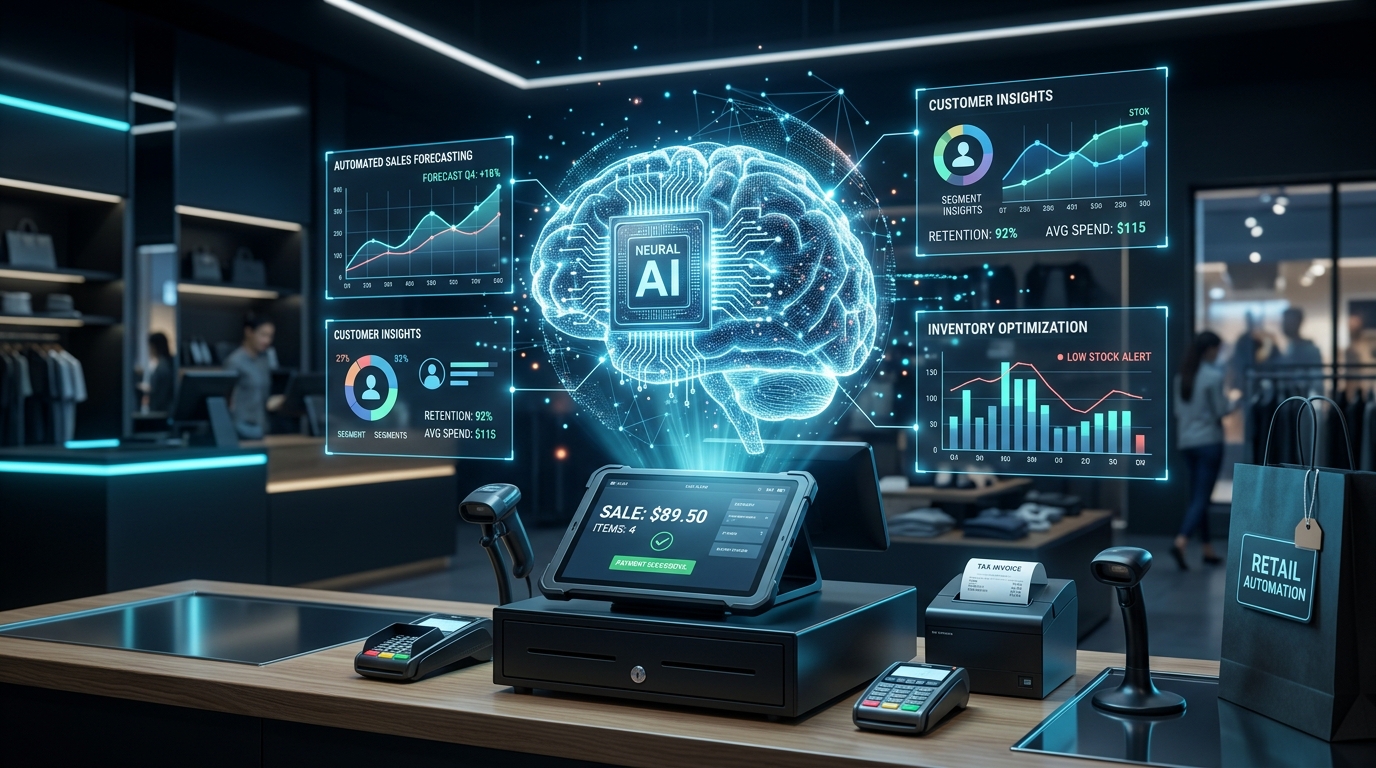
AI-Powered POS Systems integrate predictive machine learning models into traditional billing software to automate inventory replenishment, dynamically forecast customer demand, and prevent cash register shrinkage.
- Core Applications: Automated purchase order triggers, customer purchase propensity modeling, and fraud anomaly detection.
- Efficiency Gains: Lowers deadstock carrying costs by up to 28% and boosts average order value (AOV) by 14% through smart recommendations.
- Accessibility: Built natively into modern POS databases, requiring zero data science expertise from store staff.
The Evolution: From Transaction Ledger to Intelligent Business Brain
For decades, the retail Point of Sale was simply an electronic calculator connected to a thermal printer. It told business owners what happened in the past, but offered zero forward guidance.
Today, integrating Artificial Intelligence and machine learning transforms the POS into a predictive operational co-pilot.
According to retail analytics data analyzed by Billing Computer, businesses deploying automated AI-assisted inventory alerts experience 34% fewer stockouts on high-margin products and reduce working capital tied up in slow-moving deadstock by 28%.
4 Transformative Capabilities of AI-Enhanced POS
1. Predictive Demand Forecasting & Smart Reordering
Traditional reordering relies on static minimum stock numbers that ignore real-world context. AI forecasting analyzes:
- Day-of-week sales velocity and pay-cycle surges
- Upcoming public holidays and regional shopping seasons
- Supplier delivery lead times to generate precise replenishment quantities
2. Intelligent Basket Analysis & Upselling Prompts
When a cashier scans a primary item (e.g., a formal men’s suit), the system immediately displays context-aware accessories (e.g., matching silk ties or cufflinks) directly on the customer-facing display or cashier screen, boosting checkout average order value (AOV).
3. Automated Fraud Detection & Anomaly Audits
AI monitoring tracks cashier operational patterns to detect:
- Excessive item voids or line deletions before finalizing cash totals
- Repeated manual price overwrites without supervisory authorization
- Unmatched cash drawer openings outside active billing cycles
4. Customer Segmentation & Predictive Loyalty
Rather than sending generic discount SMS blasts, AI segments your customer database based on recency, frequency, and monetary spend (RFM), triggering automated personalized discounts to re-engage customers at risk of churn.
Traditional POS vs. Next-Gen AI-Driven POS
| Capability | Legacy Cash Register / Basic POS | Modern AI-Driven POS (Billing Computer) |
|---|---|---|
| Inventory Ordering | Manual counting & subjective guesses | Predictive automated purchase orders |
| Deadstock Identification | Discovered at end-of-year audit | Early-warning automated clearance prompts |
| Customer Marketing | Generic untargeted promotions | Personalized RFM purchase recommendations |
| Cashier Theft Detection | Manual review of paper tapes | Real-time machine learning audit triggers |
| Sales Reporting | Static PDF tables and spreadsheets | Natural language actionable business summaries |
| Multi-Store Balancing | Manual stock transfer requests | Automated inter-branch stock rebalancing |
How to Prepare Your Retail Store for AI Automation
Adopting AI-driven retail workflows does not require replacing your entire store infrastructure:
- Maintain Clean Item Master Data: Accurate category tagging, cost pricing, and standardized barcodes form the baseline training data for machine learning models.
- Track Every Vendor Purchase: Consistently log supplier invoices to help algorithms calculate vendor lead times and cost fluctuations.
- Choose an Extensible POS Platform: Select software like Billing Computer Smart POS that receives regular automated updates without requiring complex manual server maintenance.
Frequently Asked Questions (FAQ)
No. AI enhances human staff by handling tedious calculations, inventory auditing, and reorder planning. This frees store managers and sales associates to focus on customer service and store merchandising.
Basic inventory trends and sales velocity alerts start operating within 7 to 14 days of regular store billing data, with prediction accuracy continually refining over 30 to 60 days.